Design demo · Healthcare AI · Built on MAX
MARA
Medical Agentic Resident Assistant (MARA): MAX pointed at healthcare. It learns from every encounter across patients, providers, prescriptions, diagnoses, treatments, payers, claims and cohorts; it brings insight and a recommendation to every person caring for the patient; and it never makes the decision.
The demo runs entirely in your browser, makes no network calls, and uses fictional data throughout. Start with the guided tour: it explains every screen as you reach it.

MARA is a design and an interactive demo, not a medical device and not a production system. Every person, plan, identifier and amount in the demo is fictional; its integrations are stubs that show the real message shapes; its AI outputs are scripted to show the behaviour the design requires. The regulations it models describe the design’s intent and would be confirmed by regulatory counsel before any real use.
The rule it is built around: MARA provides insight and recommendations from all the data it can see. A licensed or accountable person makes every clinical, coverage and payment decision, and can accept a recommendation, change it with a reason, or escalate it.
Each word is a commitment
- Medical — clinical care and everything around it: scheduling, pharmacy, coding, billing, claims and coverage, because a patient’s care does not stop at the exam-room door.
- Agentic — it acts on its own initiative to gather, check, prepare and follow up. It pulls a record, runs an eligibility check, drafts a note, notices a missing answer, and asks the question nobody asked.
- Resident — like a resident physician it works beside the people who are accountable, prepares the work, and learns from every case. Unlike a resident, it never signs.
- Assistant — its output is insight and a recommendation with the evidence behind it. The decision, and the signature, belong to a person.
The problem: care arrives in pieces
A sprained or broken ankle is a small medical event. It still touches fifteen people in a dozen systems, and each of them re-asks, re-keys or re-checks something the last one already knew.
Medication lists drift between the pharmacy and the chart. An X-ray is repeated because the first one sits in another hospital’s archive. A claim is denied because a prior authorization was never requested, or because a plan that ended in December is still listed first. And almost nothing learns from what happened afterwards: whether the ankle healed, whether the patient came back, whether the cheaper plan of care worked as well as the expensive one.
One encounter, every role
The demo follows Dana Whitfield, 34, who falls from a curb and cannot put weight on her right ankle. Her episode runs through eleven steps across four lanes, and every step has the same shape: MARA prepares and recommends, the person in that seat decides, and the step is written to an audit ledger with the rule behind it and who decided.
- Triage — the nurse works the ankle-injury protocol; MARA hears the answers in the call, flags the red-flag question nobody asked, and works out the protocol’s level of care.
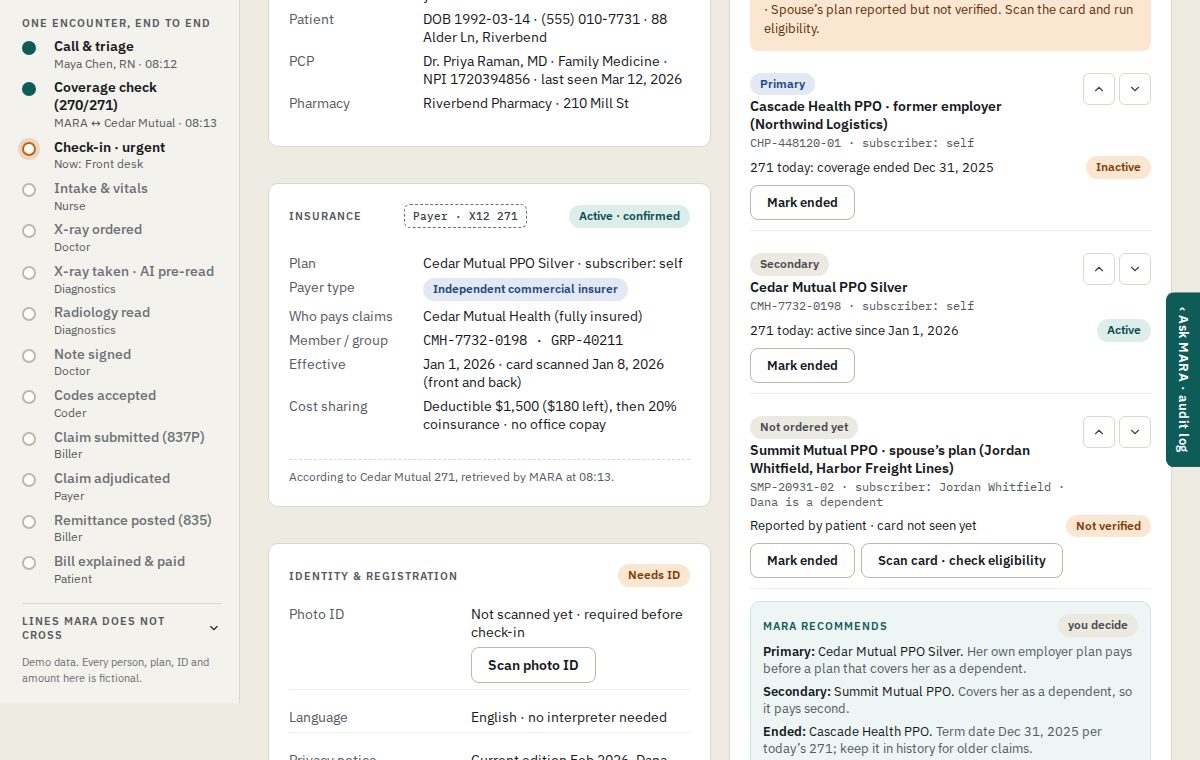
- Scheduling, eligibility and check-in — a same-day slot, an electronic coverage check, and a coverage-order check that catches a former employer’s plan still listed first.
- Intake and the visit — vitals against her own history, a reconciled medication list, screening questions, the exam and the X-ray order.
- Imaging and the specialist — an AI pre-read with the suspected fracture marked, the radiologist’s signed report, and an orthopaedic plan.
- Pharmacy, coding and billing — an interaction check against everything she takes, codes tied to the exact wording of the note, and the claim.
- The insurer — prior authorization, the claim decision with the rule it rests on, the letters and notices, and her history across plans.
- The patient — her results once signed, her bill explained line by line, her privacy choices, corrections to her record, and follow-up questions at two and six weeks.
Asking the right questions
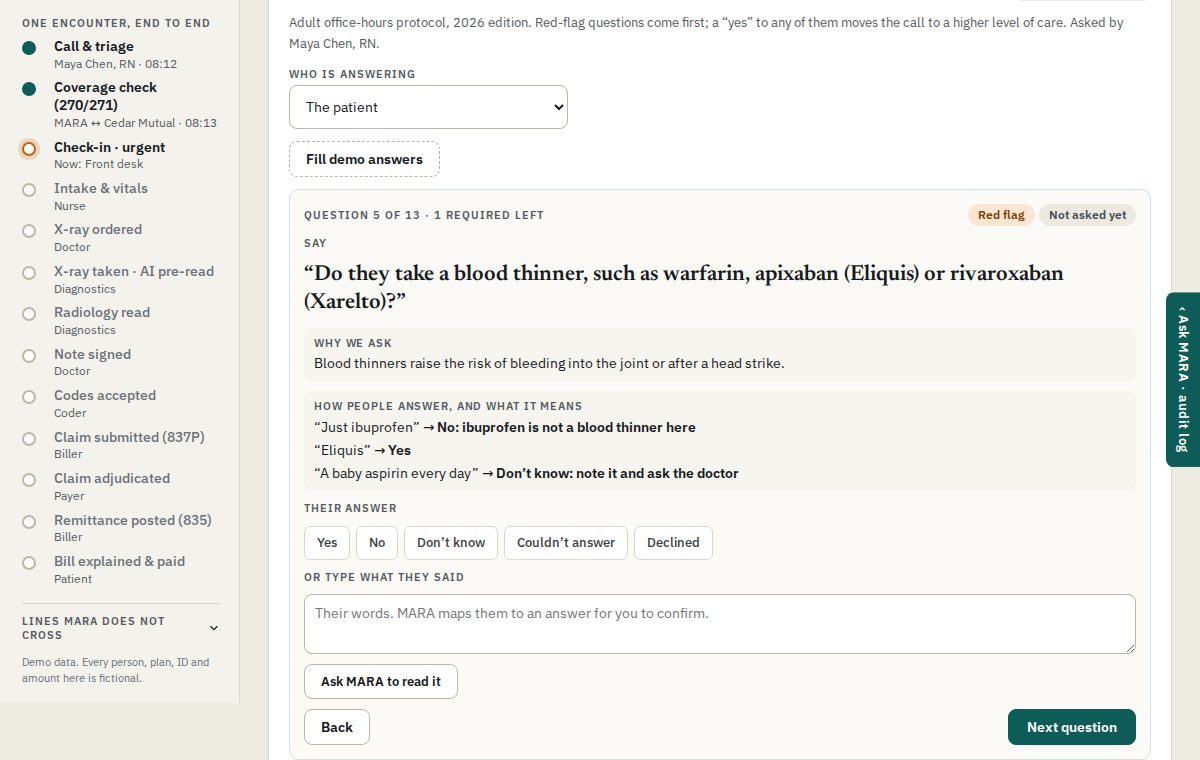
Much of healthcare is asking questions: the triage protocol, registration, the Medicare Secondary Payer questions, intake screening, the pharmacist’s counselling. Every role that asks gets the same tool in two modes. Expert mode puts every question on one screen with one-click answers. Wizard mode takes a newer staff member through one question at a time, with the words to say, why the question matters, and how people usually answer.
Every answer records who gave it — the patient, or someone else and their relation — and a person can type what was actually said. MARA reads the words, suggests the protocol answer with a confidence score, and when the answer is vague suggests the next question. “A little tingly earlier but fine now” does not become a clean no; it becomes a follow-up: is it there right now?
What it hopes to achieve
Healthcare already knows more than it can use. Every visit, prescription, test, claim and recovery is written down somewhere, and almost none of it comes back to help the next patient. MARA is a design for changing that.
- Lower cost of care — fewer repeated tests and images, avoidable emergency visits, readmissions, denials and appeals, and less re-keying of what another system already holds. Measured as the cost of a whole episode for a cohort, with outcomes held level or better.
- Better outcomes that last — every recommendation graded by recovery, return visits and complications rather than by approval, so the advice that works for patients like this one rises. Measured by recovery and relapse per cohort, over years rather than days.
- More available care — every minute taken off paperwork, phone tag and re-checking is a minute a nurse or doctor gives back to a patient. Guided questions let newer staff work safely, remote check-ins reach people between visits, and a complete chart makes a first visit with a new provider as good as a tenth.
- Safer care — interactions, allergies, duplicate therapy, missed red flags and stale coverage caught at the moment they enter the record.
- Fairness that is checked — every change to what MARA recommends tested for bias across age, sex, race, language and payer before it ships.
Cradle to grave, across a whole population
A person’s health is one story told across a lifetime, dozens of clinicians and several insurers, and today it is kept in fragments that forget each other. MARA is designed to keep the whole story in one graph — birth and childhood, the sports injury at sixteen, the blood pressure that has climbed for ten years, the knee replaced at sixty-eight — each entry with its source, date and confidence, and consent deciding who may see it.
Read across a whole population, de-identified and with consent, those lifetimes answer what no single visit can: which treatments led to lasting recovery for people like this, which led to relapse years later, which cost more without doing more, and which groups were served worse than others. Outcomes are measured by cohort, over a lifetime, and a pattern influences a recommendation only once the cohort is large enough to trust and the finding has survived review.
Then the knowledge comes back to one person. When the next patient calls with a hurt ankle, the recommendation their nurse sees is informed by everyone like them who came before, weighted by what actually worked for them over the years that followed. Population evidence improving individual care, and individual outcomes improving the evidence: that is the loop the design exists to close.
Built on MAX
- The graph is the memory. Patients, conditions (DX), treatments (TX), medications (RX), providers, payers, claims, outcomes and cohorts are nodes; the relationships between them are edges MARA traverses and reasons over.
- Confidence is first-class. Every fact carries its source, date and confidence. A question nobody answered shows as unknown, never as no.
- Curious by design. MAX detects its own gaps and turns them into questions. In MARA that is the red-flag question nobody asked on the call, the outside record nobody pulled, the follow-up nobody booked.
- It questions before it asserts. A pattern across similar patients is a hypothesis until outcomes confirm it.
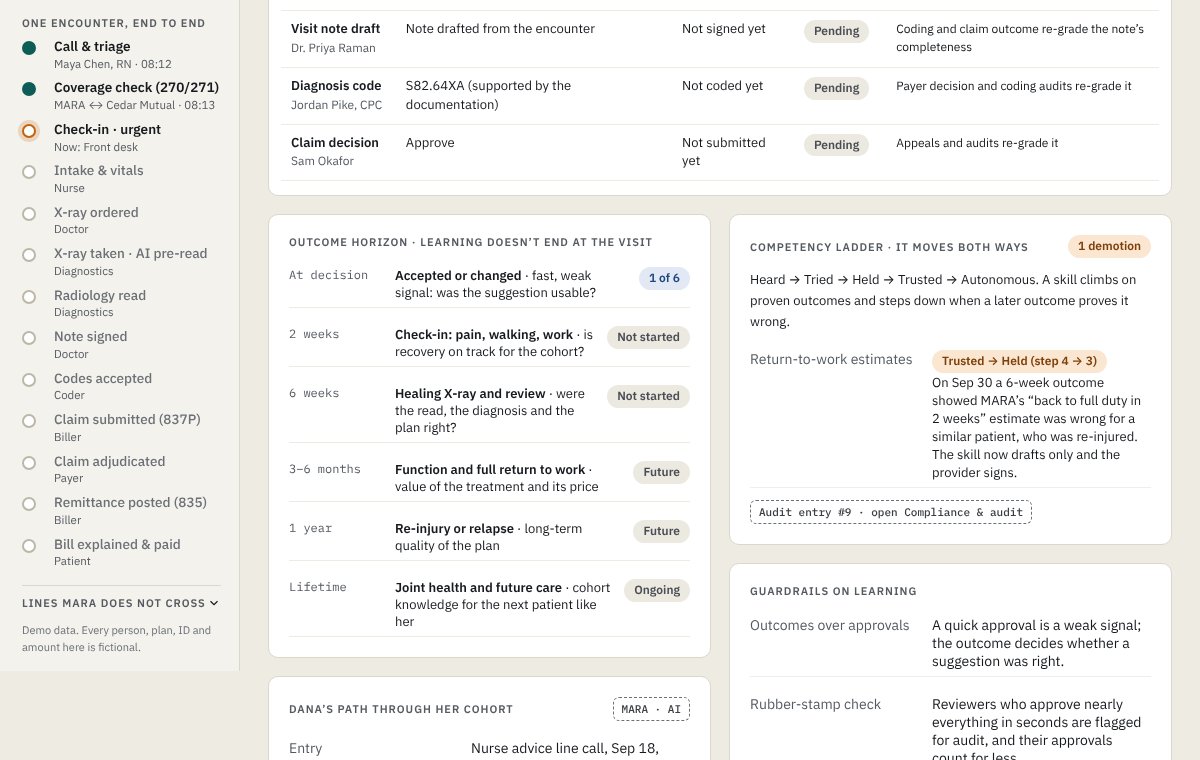
- It learns from outcomes, during and after every encounter. A recommendation that was accepted and proved wrong loses weight; a correction that proved right gains it.
- It never makes the decision. High-stakes actions sit in MAX’s recommend-only class: a person decides, and the system cannot act in their place.
Some of this exists in MAX today and some is design. The graph store, confidence scoring, gap detection, self-generated questions and outcome-weighted diagnosis memory are part of MAX. The healthcare connectors, the clinical and payer knowledge, and graph-based retrieval across a population of patients are the work further development has to do.
Outcomes outweigh approvals
A person accepting a suggestion in the moment says little about whether it was right. What says more arrives later: whether the claim was paid or overturned on appeal, whether the ankle healed by six weeks, whether the patient came back with the same injury a year later, and what the whole episode cost.
So each recommendation becomes a record in three parts — what MARA suggested, what the person did and why, and what eventually happened — and the last part re-grades the first two. A reasoned change counts for more than a quiet approval, and an outcome counts for more than either. A change to what MARA recommends ships only as a versioned release that people review, test for bias, approve and can roll back. It learns only from de-identified data where consent allows, and never from a cohort too small to trust.
What it is for
- Safer care — interactions, allergies, duplicate therapy, missed red flags and stale coverage caught where they enter.
- Less expensive care — fewer repeated tests, avoidable emergency visits and denied claims, and treatment paths priced by what they achieve for the right cohort, with outliers flagged and people signing the price.
- More comprehensive and holistic care — the injury, the medicine cabinet, the depression screen, the fall history, the home situation and the coverage in one picture, shared with every provider on the team.
- Better outcomes that last — care that does not stop when the visit does: check-ins at two and six weeks, a look back at a year, and cohorts followed across a lifetime.
Data across the seams, and an audit trail
MARA connects through the standards a clinic and an insurer already speak: FHIR R4, SMART on FHIR and CDS Hooks for the health record; HL7 v2 with LOINC for results; DICOMweb for images; TEFCA for outside records, with consent; X12 for eligibility, prior authorization, claims and remittance; the CMS-0057-F payer APIs; NCPDP SCRIPT for pharmacy; SFTP, AS2 and Direct between organizations. In the demo each is the stub it would be.
Every event goes to an append-only ledger: what happened, the rule that applied and whether it was federal, state, insurer contract or clinic policy, whether AI was involved, and who decided. The rules modelled include HIPAA, 42 CFR Part 2, the Cures Act information-blocking rules, the No Surprises Act, and coordination of benefits under the NAIC model rules, the Medicare Secondary Payer rules and Medicaid as the payer of last resort.
What MARA will never do
- Make a clinical, coverage or payment decision, or sign anything.
- Show a guess as a fact, or an unanswered question as a no.
- Learn from a patient’s data without consent, or let a pattern from too few patients drive a recommendation.
- Change a price, a plan or a model silently; every change is versioned and approved by people.
- Show anyone more of a record than their role needs.
Inside the demo
Twenty-four screens from the triage call to the insurer, plus the patient app, with a guided tour that explains what each user sees, why it matters, what MARA does and what the person decides. The Demo scenario control changes the insurer, the X-ray result and other conditions. Try typing a vague answer to a triage question, reporting a spouse’s plan at check-in, rewriting the radiology read, or denying the claim and appealing it, and watch every role’s screen follow.
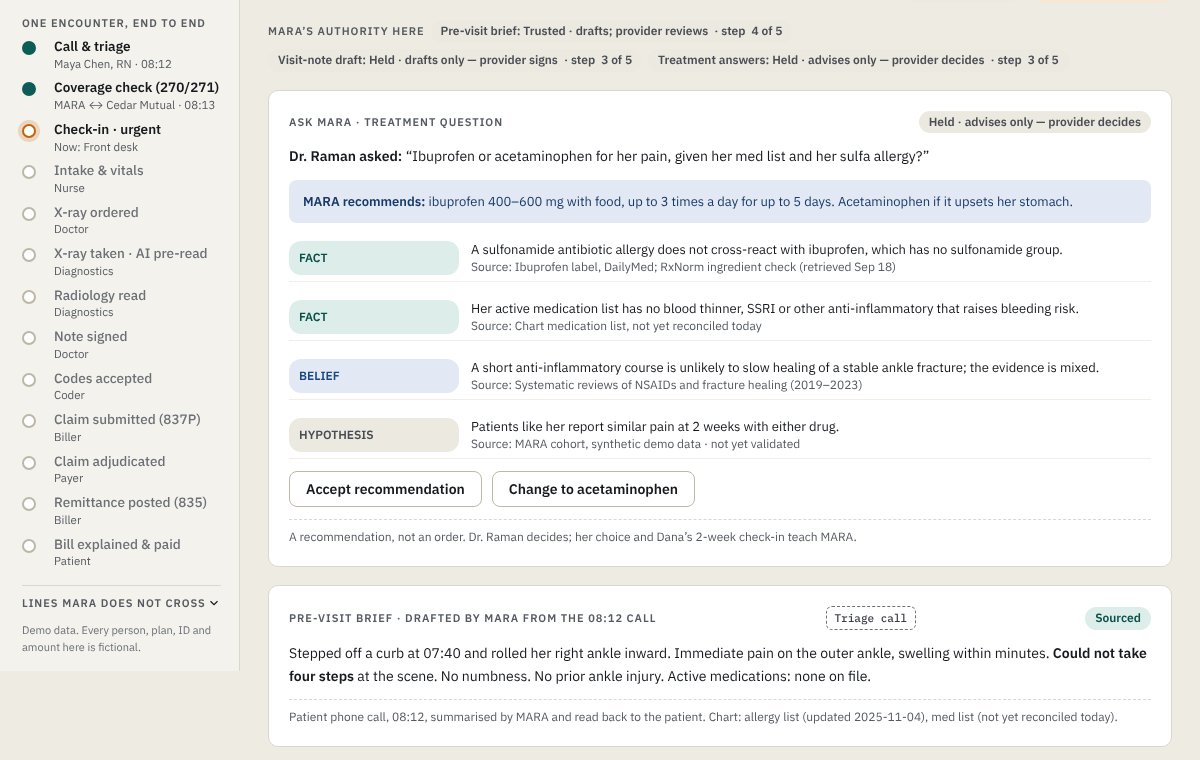
New in the demo: a check-in in the patient app that hands the patient to a clinician, a strip on each clinical and coding screen showing what MARA is allowed to do there, a treatment question on the doctor’s view answered with graded, cited sources, a record the patient supplies that stays unverified until it is matched, a card in the learning loop where a skill MARA had earned is demoted after an outcome proves a recommendation wrong, and audit columns showing which rule allowed each action and the hash chain that links the entries.